12주 복습 여보세요yeoboseyo지금 어디예요? — 기숙사에 있어요.jigeum eodiyeyo? — gisuksa-e isseoyo몇 시에 와요?myeot sie wayo?몇 시부터 시작이에요?myeot sibuteo sijagieyo? [멷 씨부터]오늘 야근 있어요?oneul yageun isseoyo?알겠습니다algetseumnida Listen and read each item again before today’s new learning.
2. 오늘의 핵심 표현 · Key expressions
일해요il-haeyoI work공부해요gongbu-haeyoI study운동해요undong-haeyoI exercise요리해요yori-haeyoI cook뭐 해요?mwo haeyo?What do you do? / What are you doing?조이가 요리해요. Joy is cooking.
낱말 + 해요: 일 + 해요 = 일해요 · 공부 + 해요 = 공부해요 · 운동 + 해요 = 운동해요 · 요리(1주) + 해요 = 요리해요 사전에는 -하다(일하다, 공부하다)로 나오지만, 사람에게 말할 때는 -해요를 써요. 일해요의 일 = work (6주). 숫자 일(1, 8주)·날짜 일(10주)과 뜻이 달라요. Word + 해요: 일해요, 공부해요, 운동해요, 요리해요 (요리 from Week 1). Dictionaries show -하다 (일하다, 공부하다), but you say -해요 when you talk to people. 일 in 일해요 means “work” (Week 6) — not the number 1 (Week 8) or a date (Week 10).
지금 뭐 해요? — 일해요.jigeum mwo haeyo? — il-haeyoWhat are you doing now? — I’m working.
저녁에 운동해요.jeonyeoge undong-haeyoI exercise in the evening.
토요일에 요리해요.toyoire yori-haeyoI cook on Saturday.
3. 듣기 · Listen
1. 들리는 말을 고르세요. Listen and choose what you hear.
2. 듣고 알맞은 뜻을 고르세요. Listen and choose the meaning.
4. 이해 · 적용 · Understand & apply
③. ‘공부하다’를 사람에게 말할 때 쓰는 형태로 바꾸세요. Change 공부하다 into the form you say to people.
④. 반장님: “지금 뭐 해요?” 알맞은 대답을 고르세요. Team leader: “지금 뭐 해요?” You are working in the factory. Choose the right answer.
⑤. 하는 일(동작)이 아닌 것을 고르세요. Choose the one that is NOT an action.
5. 문장 읽기 · Read & Record
지금 뭐 해요? — 일해요.jigeum mwo haeyo? — il-haeyoWhat are you doing now? — I’m working.
먼저 읽고 녹음하세요. / Read first, then record.
6. 말하기 · Speak
뜻이나 상황을 보고 먼저 한국어로 말한 뒤 녹음하세요. Look at the meaning or situation, say it in Korean first, then record.
I cook in the evening.
먼저 말하고 녹음하세요. / Say it first, then record.
토요일에 뭐 해요? (You exercise.)
먼저 말하고 녹음하세요. / Say it first, then record.
7. 노트에 쓰기 · Write
일해요 · 공부해요 · 운동해요 · 요리해요를 각각 3번씩 쓰고, “○요일에 ○○해요.” 문장을 2개 써 보세요. Write 일해요, 공부해요, 운동해요, and 요리해요 three times each, then write two sentences: “○요일에 ○○해요.”
Master Check
□ 낱말 + 해요로 하는 일을 말할 수 있다. I can say what I do with a word + 해요.
□ “뭐 해요?”에 알맞게 대답할 수 있다. I can answer “뭐 해요?”
문항을 틀렸다면 다시 듣고 다시 시도하세요. If you missed a question, listen again and retry.
DAY 62 · WEEK 13
만나요 · 봐요 · 자요 · 사요 · 쉬어요
매일 쓰는 동사 다섯 개를 을/를(4주)·시간 + 에(10주)와 함께 씁니다. Use five everyday verbs with 을/를 (Week 4) and time + 에 (Week 10).
Day 61 복습 일해요il-haeyo공부해요gongbu-haeyo운동해요undong-haeyo요리해요yori-haeyo지금 뭐 해요?jigeum mwo haeyo? Listen and read each item again before today’s new learning.
무엇을? → 을/를 (4주): 친구를 만나요 · 장갑을 사요 언제? → 시간 + 에 (10주): 밤 열한 시에 자요 · 일요일에 쉬어요 저기 봐요! = Look over there! (저기 11주) What? → 을/를 (Week 4): 친구를 만나요, 장갑을 사요. When? → time + 에 (Week 10): 밤 열한 시에 자요, 일요일에 쉬어요. 저기 봐요! = Look over there! (저기 from Week 11)
토요일에 친구를 만나요.toyoire chingureul mannayoI meet a friend on Saturday.
장갑을 사요.janggabeul sayoI buy gloves.
일요일에 쉬어요.iryoire swieoyoI rest on Sunday.
저기 봐요!jeogi bwayo!Look over there!
meet · look · sleep · buy · rest
3. 듣기 · Listen
1. 들리는 말을 고르세요. Listen and choose what you hear.
2. 듣고 알맞은 뜻을 고르세요. Listen and choose the meaning.
4. 이해 · 적용 · Understand & apply
③. 눈으로 하는 것을 고르세요. Which one do you do with your eyes?
④. 오늘은 휴일이에요. 뭐라고 말해요? Today is your day off. You don’t work. What do you say?
⑤. 틀린 문장을 고르세요. Choose the incorrect sentence.
5. 문장 읽기 · Read & Record
토요일에 친구를 만나요. 일요일에 쉬어요.toyoire chingureul mannayo. iryoire swieoyoI meet a friend on Saturday. I rest on Sunday.
먼저 읽고 녹음하세요. / Read first, then record.
6. 말하기 · Speak
뜻이나 상황을 보고 먼저 한국어로 말한 뒤 녹음하세요. Look at the meaning or situation, say it in Korean first, then record.
I sleep at eleven at night.
먼저 말하고 녹음하세요. / Say it first, then record.
Look over there!
먼저 말하고 녹음하세요. / Say it first, then record.
7. 노트에 쓰기 · Write
다섯 동사를 각각 3번씩 쓰고, 이번 주말에 할 일을 “○요일에 ○○을/를 ○○요.”로 2문장 써 보세요. Write the five verbs three times each, then write two sentences about this weekend: “○요일에 ○○을/를 ○○요.”
Master Check
□ 만나요·봐요·자요·사요·쉬어요의 뜻을 알 수 있다. I know the meanings of 만나요, 봐요, 자요, 사요, and 쉬어요.
□ 을/를과 시간 + 에를 넣어 문장을 만들 수 있다. I can make sentences with 을/를 and time + 에.
문항을 틀렸다면 다시 듣고 다시 시도하세요. If you missed a question, listen again and retry.
DAY 63 · WEEK 13
뭐 먹어요? — 먹어요 · 마셔요 묻고 대답하기
4주에 배운 먹어요/마셔요와 을/를을 질문(뭐 ~요?)과 부정(안 ~요)으로 넓힙니다. Extend 먹어요/마셔요 and 을/를 from Week 4 to questions (뭐 ~요?) and negatives (안 ~요).
Day 62 복습 만나요mannayo봐요bwayo자요jayo사요sayo쉬어요swieoyo Listen and read each item again before today’s new learning.
2. 오늘의 핵심 표현 · Key expressions
새 낱말은 없습니다. 이미 아는 말로 묻고 대답합니다. No new words today. Ask and answer with words you already know.
뭐 먹어요?mwo meogeoyo?What do you eat?뭐 마셔요?mwo masyeoyo?What do you drink?안 마셔요an masyeoyoI don’t drink
물을 때 → 뭐 + 동사: 뭐 먹어요? · 뭐 마셔요? 대답할 때 → ○○을/를 + 동사: 받침 있으면 을(밥을), 없으면 를(커피를) 하지 않을 때 → 안 + 동사 (4주): 커피를 안 마셔요. To ask → 뭐 + verb. To answer → noun + 을/를 + verb: 을 after a final consonant (밥을), 를 after a vowel (커피를). When you don’t do it → 안 + verb (Week 4): 커피를 안 마셔요.
점심에 뭐 먹어요? — 밥을 먹어요.jeomsime mwo meogeoyo? — babeul meogeoyoWhat do you eat for lunch? — I eat a meal.
커피를 마셔요? — 아니요, 안 마셔요. 물을 마셔요.keopireul masyeoyo? — aniyo, an masyeoyo. mureul masyeoyoDo you drink coffee? — No, I don’t. I drink water.
3. 듣기 · Listen
1. 질문을 듣고 알맞은 대답을 고르세요. Listen to the question and choose the best reply.
2. 듣고 점심에 먹는 것을 고르세요. Listen. What does she have for lunch?
4. 이해 · 적용 · Understand & apply
③. 빈칸에 알맞은 것을 고르세요: 커피___ 마셔요. Fill in the blank: 커피___ 마셔요.
④. 동료: “우유를 마셔요?” 알맞은 대답을 고르세요. Co-worker: “우유를 마셔요?” You don’t drink milk. You drink coffee. Choose the right answer.
⑤. 마시는 것을 고르세요. Which one do you DRINK?
5. 문장 읽기 · Read & Record
점심에 뭐 먹어요? — 밥을 먹어요.jeomsime mwo meogeoyo? — babeul meogeoyoWhat do you eat for lunch? — I eat a meal.
먼저 읽고 녹음하세요. / Read first, then record.
6. 말하기 · Speak
뜻이나 상황을 보고 먼저 한국어로 말한 뒤 녹음하세요. Look at the meaning or situation, say it in Korean first, then record.
동료: 뭐 마셔요? (water)
먼저 말하고 녹음하세요. / Say it first, then record.
I don’t eat apples.
먼저 말하고 녹음하세요. / Say it first, then record.
7. 노트에 쓰기 · Write
아침·점심·저녁에 먹고 마시는 것을 “○○에 ○○을/를 먹어요/마셔요.”로 3문장 쓰고, 안 먹는 것도 1문장 써 보세요. Write three sentences about what you eat and drink in the morning, at lunch, and in the evening, plus one sentence about what you don’t eat.
Master Check
□ “뭐 먹어요? / 뭐 마셔요?”로 묻고 을/를로 대답할 수 있다. I can ask “뭐 먹어요? / 뭐 마셔요?” and answer with 을/를.
□ “안 + 동사”로 하지 않는 것을 말할 수 있다. I can say what I don’t do with 안 + verb.
문항을 틀렸다면 다시 듣고 다시 시도하세요. If you missed a question, listen again and retry.
DAY 64 · WEEK 13
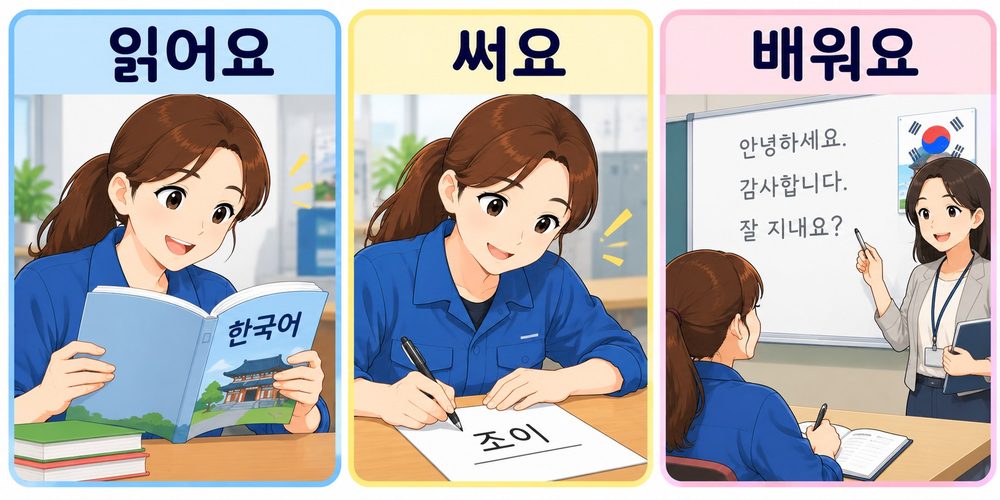
한국어를 배워요 — 읽어요 · 써요 · 배워요
공부할 때 쓰는 동사로 한국어 공부를 말합니다. Talk about studying Korean with study verbs.
Day 63 복습 뭐 먹어요?mwo meogeoyo?뭐 마셔요?mwo masyeoyo?밥을 먹어요.babeul meogeoyo커피를 안 마셔요.keopireul an masyeoyo Listen and read each item again before today’s new learning.
읽어요는 4주에 배웠어요. 소리는 [일거요]: ㄹ은 남고 ㄱ이 다음 글자로 넘어가요 (3주 연음). 한국어를 배워요 · 이름을 써요 · 책을 읽어요 You learned 읽어요 in Week 4. It sounds like [일거요]: ㄹ stays and ㄱ moves to the next syllable (linking, Week 3). 한국어를 배워요 · 이름을 써요 · 책을 읽어요
한국어를 배워요.hangugeoreul baewoyoI learn Korean.
이름을 써요.ireumeul sseoyoI write my name.
저녁에 책을 읽어요.jeonyeoge chaegeul ilgeoyoI read a book in the evening.
Read · Write · Learn Korean
3. 듣기 · Listen
1. 들리는 말을 고르세요. Listen and choose what you hear.
2. 듣고 알맞은 뜻을 고르세요. Listen and choose the meaning.
4. 이해 · 적용 · Understand & apply
③. “뭐 배워요?”에 알맞은 대답을 고르세요. Choose the best reply to “뭐 배워요?”
④. ‘읽어요’는 어떻게 소리 나요? How is ‘읽어요’ pronounced?
⑤. 어색한 문장을 고르세요. Choose the sentence that does not make sense.
5. 문장 읽기 · Read & Record
저녁에 한국어를 배워요. 책을 읽어요.jeonyeoge hangugeoreul baewoyo. chaegeul ilgeoyoI learn Korean in the evening. I read a book.
먼저 읽고 녹음하세요. / Read first, then record.
6. 말하기 · Speak
뜻이나 상황을 보고 먼저 한국어로 말한 뒤 녹음하세요. Look at the meaning or situation, say it in Korean first, then record.
I write my name.
먼저 말하고 녹음하세요. / Say it first, then record.
동료: 뭐 배워요?
먼저 말하고 녹음하세요. / Say it first, then record.
7. 노트에 쓰기 · Write
한국어 · 배워요 · 써요 · 읽어요를 각각 3번씩 쓰고, 내 이름을 한글로 3번 써 보세요. Write 한국어, 배워요, 써요, and 읽어요 three times each, then write your name in Hangul three times.
Master Check
□ 읽어요·써요·배워요의 뜻을 구별할 수 있다. I can tell 읽어요, 써요, and 배워요 apart.
□ “한국어를 배워요.”로 내 공부를 말할 수 있다. I can talk about my studies: “한국어를 배워요.”
문항을 틀렸다면 다시 듣고 다시 시도하세요. If you missed a question, listen again and retry.
DAY 65 · WEEK 13
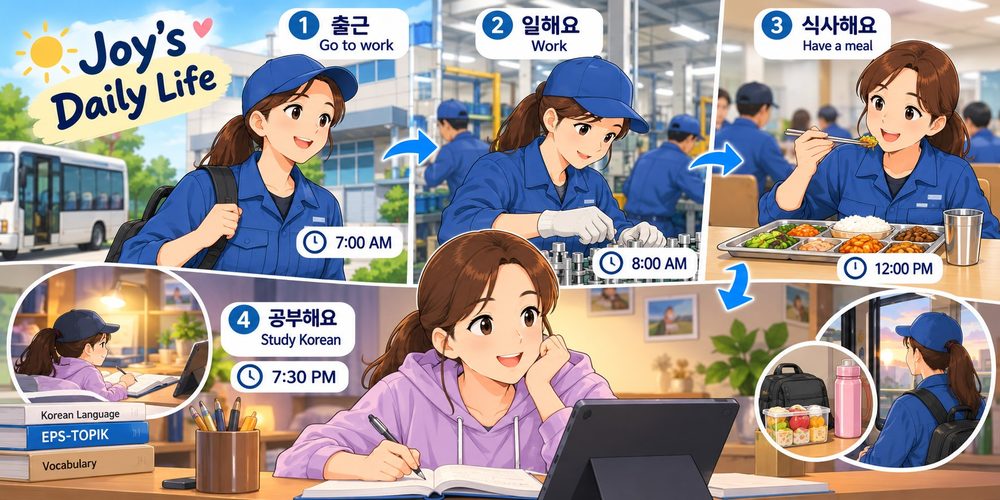
조이의 하루 · 일해요 → 일합니다 (격식체 맛보기)
이번 주 동사로 하루를 말하고, 반장님·사장님께 쓰는 격식체(-ㅂ니다)를 알아봅니다. 다음 주(14주)에는 “어제 뭐 했어요?”로 지난 일을 말합니다. Tell your day with this week’s verbs, and recognize the formal style (-ㅂ니다) used with team leaders and bosses. Next week (Week 14) you will talk about the past: “어제 뭐 했어요?”
Day 64 복습 한국어hangugeo배워요baewoyo써요sseoyo읽어요ilgeoyo한국어를 배워요.hangugeoreul baewoyo Listen and read each item again before today’s new learning.
2. 오늘의 핵심 표현 · Key expressions
조이의 하루 — 듣고 따라 읽으세요. Joy’s day — listen and read along.
아침 여덟 시에 회사에 가요.achim yeodeol sie hoesa-e gayoI go to the company at eight in the morning.
일해요. 점심에 밥을 먹어요.il-haeyo. jeomsime babeul meogeoyoI work. I eat a meal at lunch.
저녁에 한국어를 공부해요.jeonyeoge hangugeoreul gongbu-haeyoI study Korean in the evening.
밤 열한 시에 자요.bam yeolhan sie jayoI sleep at eleven at night.
일합니다ilhamnidaI work (formal)갑니다gamnidaI go (formal)공부합니다gongbuhamnidaI study (formal)
같은 뜻, 더 격식 있는 말 → -ㅂ니다: 일해요 → 일합니다 · 공부해요 → 공부합니다 · 가요 → 갑니다 이미 아는 말도 이 형태예요: 감사합니다 · 죄송합니다 · 알겠습니다 · 수고하셨습니다 반장님·사장님께, 회의·방송에서 많이 들어요. 오늘은 알아보기만 하고, 19주에 자세히 배워요. Same meaning, more formal → -ㅂ니다: 일해요 → 일합니다, 공부해요 → 공부합니다, 가요 → 갑니다. You already know some: 감사합니다, 죄송합니다, 알겠습니다, 수고하셨습니다. You hear it with team leaders and bosses, at meetings, and in announcements. Today just recognize it — you will learn it fully in Week 19.
퇴근할 때 — 반장님과 조이Leaving work — the team leader and Joy
반장님: 조이 씨, 오늘 수고하셨습니다.joi ssi, oneul sugohasyeotseumnidaJoy, good work today.
조이: 감사합니다. 먼저 갑니다.gamsahamnida. meonjeo gamnidaThank you. I’m heading out now.
반장님: 네, 내일 봐요.ne, naeil bwayoOkay, see you tomorrow.
③. ‘운동해요’를 격식체로 바꾸세요. Change 운동해요 into the formal style.
④. 가장 격식 있는 말을 고르세요. At a company meeting, you thank the company owner. Choose the most formal expression.
⑤. ‘조이의 하루’와 맞지 않는 것을 고르세요. Choose the sentence that does NOT match “Joy’s day.”
5. 문장 읽기 · Read & Record
감사합니다. 먼저 갑니다.gamsahamnida. meonjeo gamnidaThank you. I’m heading out now.
먼저 읽고 녹음하세요. / Read first, then record.
6. 말하기 · Speak
뜻이나 상황을 보고 먼저 한국어로 말한 뒤 녹음하세요. Look at the meaning or situation, say it in Korean first, then record.
요리해요 → formal style
먼저 말하고 녹음하세요. / Say it first, then record.
To the company owner: “I work.” (formal)
먼저 말하고 녹음하세요. / Say it first, then record.
7. 노트에 쓰기 · Write
“조이의 하루”를 내 하루로 바꿔 4문장으로 써 보세요. 일해요 → 일합니다, 가요 → 갑니다도 한 번씩 써 보세요. Rewrite “Joy’s day” as your own day in four sentences. Also write 일해요 → 일합니다 and 가요 → 갑니다 once each.
Master Check
□ 이번 주 동사로 내 하루를 말할 수 있다. I can describe my day with this week’s verbs.
□ -해요와 -합니다가 같은 뜻이고, -합니다가 더 격식 있다는 것을 안다. I know -해요 and -합니다 mean the same, and -합니다 is more formal.
문항을 틀렸다면 다시 듣고 다시 시도하세요. If you missed a question, listen again and retry.
SATURDAY · WEEK 13 REVIEW
13주차 누적 복습 · 매일 쓰는 동사
이번 주의 해요 동사, 일상 동사, 먹어요/마셔요 묻고 대답하기, 공부 동사, 격식체를 다시 확인합니다. Review this week’s 해요 verbs, everyday verbs, eating and drinking questions, study verbs, and the formal style.
Q1. 듣고 알맞은 뜻을 고르세요. Listen and choose the meaning.
Q2. 듣고 알맞은 뜻을 고르세요. Listen and choose the meaning.
Q3. 듣고 이 사람이 배우는 것을 고르세요. Listen. What does he learn?
3. 구별·선택 · 5분 Distinguish & choose · 5 min
Q4. 빈칸에 알맞은 것을 고르세요: 밥___ 먹어요. Fill in the blank: 밥___ 먹어요.
Q5. 격식체를 고르세요. Choose the formal style.
Q6. ‘친구를 ___’에 가장 알맞은 동사를 고르세요. Choose the verb that best fits “친구를 ___”.
Q7. 밤 열한 시예요. 뭐 해요? It is 11 at night. You are very tired and go to bed. What do you do?
4. 단어·문장 읽기 · 6분 Read words & sentences · 6 min
문장을 소리 내어 읽고 녹음합니다. Read the sentences aloud and record.
아침에 운동해요.achime undong-haeyoI exercise in the morning.
저녁에 한국어를 공부해요.jeonyeoge hangugeoreul gongbu-haeyoI study Korean in the evening.
먼저 읽고 녹음하세요. / Read first, then record.
Q8. 읽고 알맞은 뜻을 고르세요: 토요일에 한국어를 배워요. Read and choose the meaning: 토요일에 한국어를 배워요.
5. 말하기 · 5분 Speaking · 5 min
뜻이나 상황을 보고 먼저 한국어로 말한 뒤 녹음합니다. Look at the meaning or situation, say it in Korean first, then record.
일요일에 뭐 해요? (You rest.)
먼저 말하고 녹음하세요. / Say it first, then record.
I don’t drink coffee.
먼저 말하고 녹음하세요. / Say it first, then record.
감사해요 → formal style
먼저 말하고 녹음하세요. / Say it first, then record.
6. 최종 확인·쓰기 · 5분 Final check & writing · 5 min
Q9. 어색한 대화를 고르세요. Choose the conversation that does not make sense.
Q10. ‘I buy water.’에 맞는 문장을 고르세요. Choose the sentence for “I buy water.”
노트에 쓰기 · Writing
이번 주에 어려웠던 동사 3개를 골라 각각 3번씩 쓰고, 내 하루를 4문장으로 써 보세요. Choose three difficult verbs and write each three times, then write about your day in four sentences.
7. 오답 재학습 · 2분 Review mistakes · 2 min
틀린 문제만 다시 풀기 → 해당 Day로 돌아가 다시 듣기 → 소리 내어 다시 말하기 Redo only the questions you missed → go back to that day and listen again → say it aloud again.
다시 볼 수업 Lessons to revisit:
Master Check
□ 낱말 + 해요, 만나요·봐요·자요·사요·쉬어요로 내가 하는 일을 말할 수 있다. I can say what I do with word + 해요 and 만나요, 봐요, 자요, 사요, 쉬어요.
□ “뭐 먹어요? / 뭐 배워요?”로 묻고 을/를로 대답할 수 있다. I can ask “뭐 먹어요? / 뭐 배워요?” and answer with 을/를.
□ -해요와 -합니다(격식체)를 구별할 수 있다. I can tell -해요 and -합니다 (formal) apart.
□ 정답률 80% 미만인 단계는 다음 주 첫 수업 전에 한 번 더 복습합니다.Review any step below 80% accuracy once more before the first lesson next week.
Sunday · Rest 일요일은 쉽니다.
WEEK 14 지난 일 · 안 · 못 — 했어요 · 안 갔어요 · 못 가요 · 아니에요 The past and saying no: did, didn’t, couldn’t, is not
DAY 66 · WEEK 14
했어요 · 갔어요 — 지난 일 말하기 (과거 1)
-았어요/었어요로 지난 일을 말합니다. Talk about the past with -았어요/었어요.
Day 65 복습 아침 여덟 시에 회사에 가요.achim yeodeol sie hoesa-e gayo일합니다 · 갑니다ilhamnida · gamnidaI work · I go (formal)감사합니다. 먼저 갑니다.gamsahamnida. meonjeo gamnida Listen and read each item again before today’s new learning.
Day 66 복습 했어요haesseoyodid갔어요gasseoyowent왔어요wasseoyocame먹었어요meogeosseoyoate마셨어요masyeosseoyodrank Listen and read each item again before today’s new learning.
Day 67 복습 어제 뭐 했어요?eoje mwo haesseoyo?지난주 · 주말jinanju · jumallast week · weekend만났어요 · 봤어요mannasseoyo · bwasseoyomet · saw샀어요 · 쉬었어요sasseoyo · swieosseoyobought · rested Listen and read each item again before today’s new learning.
2. 오늘의 핵심 표현 · Key expressions
안 갔어요an gasseoyoI didn’t go안 먹었어요an meogeosseoyoI didn’t eat공부 안 해요gongbu an haeyoI don’t study일 안 했어요il an haesseoyoI didn’t work
안은 1개월 Day 19에서 배웠어요 (안 가요). 오늘은 두 가지를 더해요. ① 과거: 안 + 갔어요 → 안 갔어요, 안 먹었어요 ② “낱말 + 해요” 동사는 안이 가운데에 와요: 공부 안 해요, 일 안 했어요. You learned 안 in Month 1, Day 19 (안 가요). Today adds two things. ① Past: 안 + 갔어요 → 안 갔어요, 안 먹었어요. ② With word + 해요 verbs, 안 goes in the middle: 공부 안 해요, 일 안 했어요.
어제 회사에 안 갔어요.eoje hoesa-e an gasseoyoI didn’t go to the company yesterday.
아침에 밥을 안 먹었어요.achime babeul an meogeosseoyoI didn’t eat in the morning.
일요일에는 공부 안 해요.iryoireneun gongbu an haeyoI don’t study on Sundays.
3. 듣기 · Listen
1. 듣고 알맞은 뜻을 고르세요. Listen and choose the meaning.
2. 대화를 듣고 맞는 것을 고르세요. Listen. Did he go to the company yesterday?
4. 이해 · 적용 · Understand & apply
③. ‘I don’t study.’에 맞는 문장을 고르세요. Choose the sentence for “I don’t study.”
④. ‘가요’를 안 + 과거로 바꾸세요. Change 가요 into 안 + past.
⑤. 상황에 맞는 대답을 고르세요. Team leader: “아침 먹었어요?” You never eat in the morning, so you didn’t eat today. Choose your answer.
5. 문장 읽기 · Read & Record
어제 회사에 안 갔어요. 쉬었어요.eoje hoesa-e an gasseoyo. swieosseoyoI didn’t go to the company yesterday. I rested.
먼저 읽고 녹음하세요. / Read first, then record.
6. 말하기 · Speak
뜻이나 상황을 보고 먼저 한국어로 말한 뒤 녹음하세요. Look at the meaning or situation, say it in Korean first, then record.
Say “I didn’t work yesterday.”
먼저 말하고 녹음하세요. / Say it first, then record.
Say “I don’t drink coffee.”
먼저 말하고 녹음하세요. / Say it first, then record.
7. 노트에 쓰기 · Write
안 갔어요 · 안 먹었어요 · 공부 안 해요를 3번씩 쓰고, 어제 안 한 일을 2문장 써 보세요. Write the three forms three times each, then write two sentences about things you didn’t do yesterday.
Master Check
□ 안을 과거와 함께 쓸 수 있다. I can use 안 with the past.
□ “낱말 + 해요” 동사에서 안의 자리를 안다. I know where 안 goes in word + 해요 verbs.
문항을 틀렸다면 다시 듣고 다시 시도하세요. If you missed a question, listen again and retry.
DAY 69 · WEEK 14
못 갔어요 · 학생이 아니에요 — 못 넓히기와 아니에요
못을 과거에 쓰고, 아니에요로 “~이/가 아니에요”를 말합니다. Use 못 with the past, and say “is not” with 아니에요.
Day 68 복습 안 갔어요an gasseoyoI didn’t go안 먹었어요an meogeosseoyoI didn’t eat공부 안 해요gongbu an haeyoI don’t study어제 회사에 안 갔어요.eoje hoesa-e an gasseoyo Listen and read each item again before today’s new learning.
못 = 하고 싶지만 할 수 없어요 (1개월 Day 19). 과거: 못 갔어요, 못 만났어요. 이유는 문장을 하나 더 말해요: 어제 야근했어요. 친구를 못 만났어요. 아니에요 = 이에요/예요의 반대: 학생이 아니에요, 요리사가 아니에요 (받침 있으면 이, 없으면 가). 못 = you want to, but you can’t (Month 1, Day 19). Past: 못 갔어요, 못 만났어요. Give the reason in another sentence: 어제 야근했어요. 친구를 못 만났어요. 아니에요 is the opposite of 이에요/예요: 학생이 아니에요, 요리사가 아니에요 (이 after a final consonant, 가 after a vowel).
저는 학생이 아니에요. 회사원이에요.jeoneun haksaeng-i anieyo. hoesawonieyoI am not a student. I am an office worker.
어제 야근했어요. 친구를 못 만났어요.eoje yageunhaesseoyo. chingureul mon mannasseoyoI worked overtime yesterday. I couldn’t meet my friend.
못 가요.mot gayo [몯까요]I can’t go.
3. 듣기 · Listen
1. 듣고 알맞은 뜻을 고르세요. Listen and choose the meaning.
2. 듣고 이 사람의 직업을 고르세요. Listen and choose her job.
4. 이해 · 적용 · Understand & apply
③. 빈칸에 알맞은 것을 고르세요: 저는 학생이 ___. 회사원이에요. Fill in the blank: 저는 학생이 ___. 회사원이에요.
④. 상황에 맞는 문장을 고르세요. You wanted to meet your friend, but you had overtime work. Choose the sentence.
⑤. 틀린 문장을 고르세요. Choose the incorrect sentence.
5. 문장 읽기 · Read & Record
어제 야근했어요. 친구를 못 만났어요.eoje yageunhaesseoyo. chingureul mon mannasseoyoI worked overtime yesterday. I couldn’t meet my friend.
먼저 읽고 녹음하세요. / Read first, then record.
6. 말하기 · Speak
뜻이나 상황을 보고 먼저 한국어로 말한 뒤 녹음하세요. Look at the meaning or situation, say it in Korean first, then record.
You are not a student. Say it.
먼저 말하고 녹음하세요. / Say it first, then record.
Your friend invites you, but you have work. Say “I can’t go.”
먼저 말하고 녹음하세요. / Say it first, then record.
7. 노트에 쓰기 · Write
아니에요 · 못 갔어요 · 못 만났어요를 3번씩 쓰고, “저는 ○○이/가 아니에요.”를 써 보세요. Write 아니에요, 못 갔어요, and 못 만났어요 three times each, then write “저는 ○○이/가 아니에요.”
Master Check
□ 안과 못을 상황에 맞게 고를 수 있다. I can choose 안 or 못 for the situation.
□ “○○이/가 아니에요.”로 말할 수 있다. I can say “○○이/가 아니에요.”
문항을 틀렸다면 다시 듣고 다시 시도하세요. If you missed a question, listen again and retry.
DAY 70 · WEEK 14
주말에 뭐 했어요? — 동료와 월요일 대화
이번 주 과거·안·못으로 동료와 주말 이야기를 합니다. 다음 주(15주)에는 가족·일하는 곳·음식을 배웁니다. Talk about the weekend with a co-worker using the past, 안, and 못. Next week (Week 15): family, workplaces, and food.
Day 69 복습 아니에요anieyois not못 갔어요mot gasseoyoI couldn’t go저는 학생이 아니에요.jeoneun haksaeng-i anieyo친구를 못 만났어요.chingureul mon mannasseoyo Listen and read each item again before today’s new learning.
2. 오늘의 핵심 표현 · Key expressions
늦었어요neujeosseoyo [느저써요]I was late○○ 씨는요?(예: 민수 씨는요?)ssineunyo?How about you, ○○?
새 문법은 없어요. 늦어요(12주) → 늦었어요. 대답 뒤에 ○○ 씨는요?로 되물으면 대화가 이어져요. No new grammar. 늦어요 (Week 12) → 늦었어요. After you answer, ask back with ○○ 씨는요? to keep the conversation going.
월요일 아침, 동료 민수 씨와 조이Monday morning — Joy and her co-worker Minsu
조이 씨, 주말에 뭐 했어요?joi ssi, jumare mwo haesseoyo?Minsu: Joy, what did you do on the weekend?
토요일에 친구를 만났어요. 민수 씨는요?toyoire chingureul mannasseoyo. minsu ssineunyo?Joy: I met a friend on Saturday. How about you, Minsu?
저는 토요일에 일했어요. 일요일에 쉬었어요.jeoneun toyoire ilhaesseoyo. iryoire swieosseoyoMinsu: I worked on Saturday. I rested on Sunday.
조이 씨, 아침 먹었어요?joi ssi, achim meogeosseoyo?Minsu: Joy, did you eat breakfast?
아니요, 못 먹었어요. 늦었어요.aniyo, mon meogeosseoyo. neujeosseoyoJoy: No, I couldn’t. I was late.
여기 우유 있어요. 마셔요.yeogi uyu isseoyo. masyeoyoMinsu: Here’s some milk. Drink it.
감사합니다!gamsahamnidaJoy: Thank you!
3. 듣기 · Listen
1. 대화를 듣고 조이가 토요일에 한 일을 고르세요. Listen to the conversation. What did Joy do on Saturday?
2. 대화를 듣고 조이가 아침을 못 먹은 이유를 고르세요. Listen. Why couldn’t Joy eat breakfast?
4. 이해 · 적용 · Understand & apply
③. 대화 순서가 바른 것을 고르세요. Choose the right order.
④. 대화와 맞으면 True, 틀리면 False를 고르세요: 민수 씨는 일요일에 일했어요. True or false? “Minsu worked on Sunday.”
⑤. “아침 먹었어요?”에 어울리지 않는 대답을 고르세요. Which reply does NOT fit “아침 먹었어요?”
5. 문장 읽기 · Read & Record
토요일에 친구를 만났어요. 민수 씨는요?toyoire chingureul mannasseoyo. minsu ssineunyo?I met a friend on Saturday. How about you, Minsu?
먼저 읽고 녹음하세요. / Read first, then record.
6. 말하기 · Speak
뜻이나 상황을 보고 먼저 한국어로 말한 뒤 녹음하세요. Look at the meaning or situation, say it in Korean first, then record.
Ask your co-worker “What did you do on the weekend?”
먼저 말하고 녹음하세요. / Say it first, then record.
Your co-worker asks “아침 먹었어요?” You couldn’t eat — you were late. Answer in two sentences.
먼저 말하고 녹음하세요. / Say it first, then record.
7. 노트에 쓰기 · Write
지난 주말에 한 일을 3문장으로 쓰고, 마지막에 “○○ 씨는요?”를 써 보세요. Write three sentences about last weekend, then end with “○○ 씨는요?”
Master Check
□ 주말에 한 일을 묻고 대답할 수 있다. I can ask and answer about the weekend.
□ 안 · 못 · 아니에요로 “아니요” 대답을 할 수 있다. I can say “no” with 안, 못, and 아니에요.
문항을 틀렸다면 다시 듣고 다시 시도하세요. If you missed a question, listen again and retry.
SATURDAY · WEEK 14
14주차 누적 복습 · 과거 · 안 · 못
이번 주 과거형과 안 · 못 · 아니에요를 새로운 문제로 다시 확인합니다. Review this week’s past forms and 안, 못, and 아니에요 with new questions.
Day 70 복습 주말에 뭐 했어요?jumare mwo haesseoyo?민수 씨는요?minsu ssineunyo?아니요, 못 먹었어요. 늦었어요.aniyo, mon meogeosseoyo. neujeosseoyo Listen and read each item again before today’s new learning.
2. 오늘의 핵심 표현 · Key expressions
부모님bumonimparents형hyeongolder brother (for a man)누나nunaolder sister (for a man)오빠oppaolder brother (for a woman)언니eonniolder sister (for a woman)동생dongsaengyounger brother or sister아들adeulson딸ttaldaughter
누가 말하는지가 중요해요. 남자는 형 · 누나, 여자는 오빠 · 언니라고 불러요. 나보다 어리면 모두 동생. 가족이 몇 명이에요? (Day 43)로 다시 물어봐요: 다섯 명이에요. 부모님, 오빠, 동생, 저예요. Who is speaking matters. A man says 형 and 누나; a woman says 오빠 and 언니. Anyone younger is 동생. Ask again with 가족이 몇 명이에요? (Day 43): 다섯 명이에요. 부모님, 오빠, 동생, 저예요.
가족이 다섯 명이에요. 부모님, 오빠, 동생, 저예요.gajogi daseot myeongieyo. bumonim, oppa, dongsaeng, jeoyeyoThere are five of us: my parents, my older brother, my younger sibling, and me.
저는 언니가 있어요.jeoneun eonniga isseoyoI have an older sister.
오빠는 회사원이에요.oppaneun hoesawonieyoMy older brother is an office worker.
3. 듣기 · Listen
1. 들리는 말을 고르세요. Listen and choose what you hear.
2. 듣고 이 가족에 없는 사람을 고르세요. Listen. Who is NOT in her family?
4. 이해 · 적용 · Understand & apply
③. 여자가 자기 형제를 부를 때 알맞은 말을 고르세요. A woman calls her older brother. Which word does she use?
④. 계산해서 고르세요: 부모님 + 형 + 저 = ? Count: 부모님 + 형 + 저 = ?
⑤. ‘딸’의 뜻을 고르세요. What does 딸 mean?
5. 문장 읽기 · Read & Record
가족이 다섯 명이에요. 부모님, 오빠, 동생, 저예요.gajogi daseot myeongieyo. bumonim, oppa, dongsaeng, jeoyeyoThere are five of us: my parents, my older brother, my younger sibling, and me.
먼저 읽고 녹음하세요. / Read first, then record.
6. 말하기 · Speak
뜻이나 상황을 보고 먼저 한국어로 말한 뒤 녹음하세요. Look at the meaning or situation, say it in Korean first, then record.
Say how many people are in your family.
먼저 말하고 녹음하세요. / Say it first, then record.
You are a woman. Say “I have an older sister.”
먼저 말하고 녹음하세요. / Say it first, then record.
7. 노트에 쓰기 · Write
가족 낱말 8개를 쓰고, 내 가족을 “가족이 ○ 명이에요. ○○, ○○, 저예요.”로 써 보세요. Write the eight family words, then introduce your family: “가족이 ○ 명이에요. ○○, ○○, 저예요.”
Master Check
□ 가족을 부르는 말을 말할 수 있다. I can say the family words.
□ 말하는 사람에 따라 형·오빠, 누나·언니를 고를 수 있다. I can choose 형/오빠 and 누나/언니 by who is speaking.
문항을 틀렸다면 다시 듣고 다시 시도하세요. If you missed a question, listen again and retry.
DAY 72 · WEEK 15
어디에서 일해요? — 에서 · EPS 업종
에서로 일하는 곳을 말하고, EPS 업종 이름을 읽습니다. Say where you work with 에서, and read EPS industry names.
Day 71 복습 부모님bumonimparents오빠 · 언니oppa · eonni형 · 누나hyeong · nuna동생dongsaengyounger sibling저는 언니가 있어요.jeoneun eonniga isseoyo Listen and read each item again before today’s new learning.
2. 오늘의 핵심 표현 · Key expressions
에서eseoat (where you do something)제조업jejoeopmanufacturing건설업geonseoreopconstruction농업nong-eopagriculture어업eoeopfishing industry농장nongjangfarm
에서 = 무엇을 하는 곳: 공장에서 일해요, 식당에서 먹어요. 에 = 가는 곳, 있는 곳 (11주): 공장에 가요, 장갑이 창고에 있어요. EPS 업종: 제조업(공장), 건설업, 농업(농장), 어업. 에서 = where you DO something: 공장에서 일해요, 식당에서 먹어요. 에 = where you GO or where something IS (Week 11): 공장에 가요, 장갑이 창고에 있어요. EPS industries: 제조업 (manufacturing), 건설업 (construction), 농업 (agriculture), 어업 (fishing).
저는 공장에서 일해요.jeoneun gongjang-eseo ilhaeyoI work at a factory.
동생은 농장에서 일해요.dongsaeng-eun nongjang-eseo ilhaeyoMy younger sibling works on a farm.
어디에서 일해요?eodieseo ilhaeyo?Where do you work?
3. 듣기 · Listen
1. 듣고 알맞은 뜻을 고르세요. Listen and choose the meaning.
2. 듣고 이 사람이 일하는 곳을 고르세요. Listen. Where does she work?
4. 이해 · 적용 · Understand & apply
③. 빈칸에 알맞은 것을 고르세요: 저는 공장___ 일해요. Fill in the blank: 저는 공장___ 일해요. (I work at a factory.)
④. 빈칸에 알맞은 것을 고르세요: 장갑이 창고___ 있어요. Fill in the blank: 장갑이 창고___ 있어요. (The gloves are in the storeroom.)
⑤. 업종이 아니라 장소인 것을 고르세요. Which one is a PLACE, not an industry?
5. 문장 읽기 · Read & Record
저는 공장에서 일해요. 동생은 농장에서 일해요.jeoneun gongjang-eseo ilhaeyo. dongsaeng-eun nongjang-eseo ilhaeyoI work at a factory. My younger sibling works on a farm.
먼저 읽고 녹음하세요. / Read first, then record.
6. 말하기 · Speak
뜻이나 상황을 보고 먼저 한국어로 말한 뒤 녹음하세요. Look at the meaning or situation, say it in Korean first, then record.
Ask “Where do you work?”
먼저 말하고 녹음하세요. / Say it first, then record.
Say “I work at a factory.”
먼저 말하고 녹음하세요. / Say it first, then record.
7. 노트에 쓰기 · Write
업종 낱말 4개와 농장을 쓰고, “저는 ○○에서 일해요.”를 써 보세요. Write the four industry words and 농장, then write “저는 ○○에서 일해요.”
Master Check
□ 에서와 에를 구별해서 쓸 수 있다. I can tell 에서 from 에.
□ EPS 업종 이름을 읽을 수 있다. I can read the EPS industry names.
문항을 틀렸다면 다시 듣고 다시 시도하세요. If you missed a question, listen again and retry.
DAY 73 · WEEK 15
뭐 먹어요? — 김치 · 생선 · 채소 · 과일 · 라면
음식 이름을 알고, 먹는 것과 안 먹는 것을 말합니다. Learn food words and say what you eat and don’t eat.
Day 72 복습 에서eseoat (where you do something)제조업 · 건설업jejoeop · geonseoreop농업 · 어업nong-eop · eoeop저는 공장에서 일해요.jeoneun gongjang-eseo ilhaeyo Listen and read each item again before today’s new learning.
음식 + 을/를 + 먹어요 (13주): 김치를 먹어요, 생선을 먹어요. 안 먹으면 → 생선을 안 먹어요. 사과는 과일이에요. 밥, 우유, 커피는 이미 배웠어요. Food + 을/를 + 먹어요 (Week 13): 김치를 먹어요, 생선을 먹어요. If you don’t eat it → 생선을 안 먹어요. 사과 is a fruit. You already know 밥, 우유, and 커피.
생선을 안 먹어요.saengseoneul an meogeoyoI don’t eat fish.
아침에 과일을 먹었어요.achime gwaireul meogeosseoyoI ate fruit in the morning.
3. 듣기 · Listen
1. 듣고 알맞은 뜻을 고르세요. Listen and choose the meaning.
2. 듣고 점심에 먹은 것을 고르세요. Listen. What did he eat for lunch?
4. 이해 · 적용 · Understand & apply
③. 빈칸에 알맞은 것을 고르세요: 채소___ 먹어요. Fill in the blank: 채소___ 먹어요.
④. ‘사과’는 무엇이에요? What kind of food is 사과?
⑤. 상황에 맞는 대답을 고르세요. Co-worker: “생선 먹어요?” You don’t eat fish. Choose your answer.
5. 문장 읽기 · Read & Record
저는 김치를 먹어요. 생선을 안 먹어요.jeoneun gimchireul meogeoyo. saengseoneul an meogeoyoI eat kimchi. I don’t eat fish.
먼저 읽고 녹음하세요. / Read first, then record.
6. 말하기 · Speak
뜻이나 상황을 보고 먼저 한국어로 말한 뒤 녹음하세요. Look at the meaning or situation, say it in Korean first, then record.
Say “I eat fruit in the morning.”
먼저 말하고 녹음하세요. / Say it first, then record.
Say “I don’t eat ramyeon.”
먼저 말하고 녹음하세요. / Say it first, then record.
7. 노트에 쓰기 · Write
음식 낱말 5개를 쓰고, 먹는 것 2개와 안 먹는 것 1개를 문장으로 써 보세요. Write the five food words, then write two sentences about foods you eat and one about a food you don’t eat.
Master Check
□ 음식 이름을 말할 수 있다. I can name foods.
□ 먹는 것과 안 먹는 것을 말할 수 있다. I can say what I eat and don’t eat.
문항을 틀렸다면 다시 듣고 다시 시도하세요. If you missed a question, listen again and retry.
DAY 74 · WEEK 15
라면 하나 주세요 — 맛있어요 · 매워요
식당에서 주문하고 맛을 말합니다. Order at a restaurant and talk about taste.
Day 73 복습 김치 · 생선gimchi · saengseon채소 · 과일 · 라면chaeso · gwail · ramyeon생선을 안 먹어요.saengseoneul an meogeoyo Listen and read each item again before today’s new learning.
주문은 주세요 (1개월 Day 20): 물 주세요. 라면 하나 주세요. 라면 두 개 주세요 (9주 고유어 숫자). 맛: 맛있어요 [마시써요] = delicious, 매워요 = spicy. Order with 주세요 (Month 1, Day 20): 물 주세요. 라면 하나 주세요. 라면 두 개 주세요 (native numbers, Week 9). Taste: 맛있어요 = delicious, 매워요 = spicy.
라면 하나 주세요.ramyeon hana juseyoOne ramyeon, please.
물 주세요.mul juseyoWater, please.
김치가 매워요. 맛있어요.gimchiga maewoyo. masisseoyoThe kimchi is spicy. It’s delicious.
3. 듣기 · Listen
1. 듣고 알맞은 뜻을 고르세요. Listen and choose the meaning.
2. 듣고 라면이 몇 개인지 고르세요. Listen. How many ramyeon does he order?
4. 이해 · 적용 · Understand & apply
③. 틀린 문장을 고르세요. Choose the incorrect sentence.
④. 상황에 맞는 말을 고르세요. The kimchi burns your mouth. What do you say?
⑤. 상황에 맞는 주문을 고르세요. You want three bowls of ramyeon. What do you say?
5. 문장 읽기 · Read & Record
라면 하나 주세요. 김치가 매워요. 맛있어요.ramyeon hana juseyo. gimchiga maewoyo. masisseoyoOne ramyeon, please. The kimchi is spicy. It’s delicious.
먼저 읽고 녹음하세요. / Read first, then record.
6. 말하기 · Speak
뜻이나 상황을 보고 먼저 한국어로 말한 뒤 녹음하세요. Look at the meaning or situation, say it in Korean first, then record.
Ask for water.
먼저 말하고 녹음하세요. / Say it first, then record.
Tell your friend the food is delicious.
먼저 말하고 녹음하세요. / Say it first, then record.
7. 노트에 쓰기 · Write
맛있어요 · 매워요를 3번씩 쓰고, 식당에서 주문하는 문장을 2개 써 보세요. Write 맛있어요 and 매워요 three times each, then write two restaurant orders.
Master Check
□ 식당에서 주세요로 주문할 수 있다. I can order with 주세요.
□ 맛있어요 · 매워요로 맛을 말할 수 있다. I can talk about taste with 맛있어요 and 매워요.
문항을 틀렸다면 다시 듣고 다시 시도하세요. If you missed a question, listen again and retry.
DAY 75 · WEEK 15
뭐 드릴까요? — 식당 대화
식당에서 직원과 짧게 대화합니다. 다음 주(16주)에는 쇼핑과 교통을 배웁니다. Have a short conversation with restaurant staff. Next week (Week 16): shopping and transport.
Day 74 복습 라면 하나 주세요.ramyeon hana juseyo물 주세요.mul juseyo맛있어요masisseoyoIt’s delicious.매워요maewoyoIt’s spicy. Listen and read each item again before today’s new learning.
2. 오늘의 핵심 표현 · Key expressions
뭐 드릴까요?mwo deurilkkayo? [드릴까요]What can I get you? (staff)
뭐 드릴까요?는 직원이 손님에게 하는 말이에요. 통째로 알아 두세요. 대답: ○○ 주세요. 괜찮아요 (7주) = It’s okay. 뭐 드릴까요? is what the staff says to a customer — learn it as a whole phrase. Answer: ○○ 주세요. 괜찮아요 (Week 7) = It’s okay.
식당에서 — 직원과 조이At a restaurant — the staff and Joy
뭐 드릴까요?mwo deurilkkayo?Staff: What can I get you?
라면 하나 주세요.ramyeon hana juseyoJoy: One ramyeon, please.
라면 매워요. 괜찮아요?ramyeon maewoyo. gwaenchanayo?Staff: The ramyeon is spicy. Is that okay?
네, 괜찮아요. 물 주세요.ne, gwaenchanayo. mul juseyoJoy: Yes, it’s okay. Water, please.
맛있어요?masisseoyo?Staff (later): Is it good?
네, 맛있어요!ne, masisseoyo!Joy: Yes, it’s delicious!
3. 듣기 · Listen
1. 대화를 듣고 조이가 주문한 것을 고르세요. Listen. What did Joy order?
2. 대화를 듣고 조이가 또 부탁한 것을 고르세요. Listen. What else did Joy ask for?
4. 이해 · 적용 · Understand & apply
③. “뭐 드릴까요?”는 누가 말해요? Who says “뭐 드릴까요?”
④. 대화 순서가 바른 것을 고르세요. Choose the right order.
⑤. “맛있어요?”에 알맞은 대답을 고르세요. (맛있어요.) The staff asks “맛있어요?” You think it is delicious. Choose your answer.
5. 문장 읽기 · Read & Record
라면 하나 주세요. 물 주세요.ramyeon hana juseyo. mul juseyoOne ramyeon, please. Water, please.
먼저 읽고 녹음하세요. / Read first, then record.
6. 말하기 · Speak
뜻이나 상황을 보고 먼저 한국어로 말한 뒤 녹음하세요. Look at the meaning or situation, say it in Korean first, then record.
Staff: “뭐 드릴까요?” Order one ramyeon.
먼저 말하고 녹음하세요. / Say it first, then record.
The staff says the ramyeon is spicy and asks if that is okay. Say it is okay.
먼저 말하고 녹음하세요. / Say it first, then record.
7. 노트에 쓰기 · Write
식당 대화를 내 음식으로 바꿔 4줄로 써 보세요. Rewrite the restaurant conversation in four lines with a food you like.
Master Check
□ “뭐 드릴까요?”를 듣고 주문할 수 있다. I can order when I hear “뭐 드릴까요?”
□ 맛을 묻고 대답할 수 있다. I can ask and answer about taste.
문항을 틀렸다면 다시 듣고 다시 시도하세요. If you missed a question, listen again and retry.
SATURDAY · WEEK 15
15주차 누적 복습 · 가족 · 일하는 곳 · 음식
이번 주 가족 · 에서 · 음식 · 식당 표현을 새로운 문제로 다시 확인합니다. Review this week’s family words, 에서, food, and restaurant phrases with new questions.
Day 75 복습 뭐 드릴까요?mwo deurilkkayo?라면 하나 주세요.ramyeon hana juseyo네, 괜찮아요.ne, gwaenchanayo네, 맛있어요!ne, masisseoyo Listen and read each item again before today’s new learning.
2. 오늘의 핵심 표현 · Key expressions
얼마eolmahow much비싸요bissayoIt’s expensive.
이거 · 저거는 1개월 Day 16에서 배웠어요: 이거 = this one (가까이), 저거 = that one (저기). ○○ 얼마예요? = How much is ○○? 대답은 한자어 숫자 + 원 (8주): 오천 원이에요, 만 원이에요. 비싸요 = It’s expensive. You learned 이거 and 저거 in Month 1, Day 16: 이거 = this one (near you), 저거 = that one (over there). ○○ 얼마예요? = How much is ○○? Answer with Sino-Korean numbers + 원 (Week 8): 오천 원이에요, 만 원이에요. 비싸요 = It’s expensive.
이거 얼마예요? — 오천 원이에요.igeo eolmayeyo? — ocheon wonieyoHow much is this? — It’s 5,000 won.
저거 얼마예요? — 만 원이에요.jeogeo eolmayeyo? — man wonieyoHow much is that one? — It’s 10,000 won.
비싸요.bissayoIt’s expensive.
3. 듣기 · Listen
1. 듣고 값을 고르세요. Listen. How much is it?
2. 들리는 말을 고르세요. Listen and choose what you hear.
4. 이해 · 적용 · Understand & apply
③. 상황에 맞는 질문을 고르세요. The bag is far from you, over there. Ask its price.
④. 빈칸에 알맞은 말을 고르세요: 라면이 만 원이에요! ___ Fill in the blank: 라면이 만 원이에요! ___ (Ramyeon for 10,000 won!)
⑤. 대화를 완성하세요. A: 이거 얼마예요? B: ___ Complete the conversation. A: 이거 얼마예요? B: ___
5. 문장 읽기 · Read & Record
이거 얼마예요? — 오천 원이에요.igeo eolmayeyo? — ocheon wonieyoHow much is this? — It’s 5,000 won.
먼저 읽고 녹음하세요. / Read first, then record.
6. 말하기 · Speak
뜻이나 상황을 보고 먼저 한국어로 말한 뒤 녹음하세요. Look at the meaning or situation, say it in Korean first, then record.
Point to something near you and ask its price.
먼저 말하고 녹음하세요. / Say it first, then record.
Say “It’s expensive.”
먼저 말하고 녹음하세요. / Say it first, then record.
7. 노트에 쓰기 · Write
얼마 · 비싸요를 3번씩 쓰고, 내 물건 2개의 값을 “○○ ○○ 원이에요.”로 써 보세요. Write 얼마 and 비싸요 three times each, then write the prices of two of your things.
Master Check
□ “이거/저거 얼마예요?”라고 물을 수 있다. I can ask “이거/저거 얼마예요?”
□ 값을 듣고 알 수 있다. I can understand a price I hear.
문항을 틀렸다면 다시 듣고 다시 시도하세요. If you missed a question, listen again and retry.
DAY 77 · WEEK 16
편의점에서 — 카드 · 현금 · 봉투 · 팔아요
가게에서 물건을 사고 계산할 때 쓰는 말을 익힙니다. Learn words for buying and paying at a store.
Day 76 복습 얼마eolmahow much비싸요bissayoIt’s expensive.이거 얼마예요?igeo eolmayeyo?오천 원이에요.ocheon wonieyo Listen and read each item again before today’s new learning.
가게는 물건을 팔아요, 나는 사요: 편의점에서 물을 팔아요. 계산할 때 직원이 물어요: 봉투 드릴까요? (Day 75 드릴까요) → 네, 하나 주세요. 카드예요? — 아니요, 현금이에요. The store sells (팔아요); you buy (사요): 편의점에서 물을 팔아요. At the counter the clerk asks 봉투 드릴까요? (드릴까요 from Day 75) → 네, 하나 주세요. 카드예요? — 아니요, 현금이에요.
편의점에서 물을 팔아요.pyeonuijeomeseo mureul parayoThe convenience store sells water.
봉투 드릴까요? — 네, 하나 주세요.bongtu deurilkkayo? — ne, hana juseyoDo you want a bag? — Yes, one please.
카드예요? — 아니요, 현금이에요.kadeuyeyo? — aniyo, hyeongeumieyoCard? — No, cash.
3. 듣기 · Listen
1. 듣고 알맞은 뜻을 고르세요. Listen and choose the meaning.
2. 듣고 이 사람이 사는 것을 고르세요. Listen. What does she buy?
4. 이해 · 적용 · Understand & apply
③. 빈칸에 알맞은 말을 고르세요: 편의점에서 물을 ___. Fill in the blank: 편의점에서 물을 ___. (The store sells water.)
④. 상황에 맞는 대답을 고르세요. Clerk: “봉투 드릴까요?” You want one. Choose your answer.
⑤. 틀린 문장을 고르세요. Choose the incorrect sentence.
5. 문장 읽기 · Read & Record
사과 세 개 주세요. 봉투 하나 주세요.sagwa se gae juseyo. bongtu hana juseyoThree apples, please. One bag, please.
먼저 읽고 녹음하세요. / Read first, then record.
6. 말하기 · Speak
뜻이나 상황을 보고 먼저 한국어로 말한 뒤 녹음하세요. Look at the meaning or situation, say it in Korean first, then record.
The clerk asks “카드예요?” You pay with cash. Answer.
먼저 말하고 녹음하세요. / Say it first, then record.
Ask for two of these.
먼저 말하고 녹음하세요. / Say it first, then record.
7. 노트에 쓰기 · Write
카드 · 현금 · 봉투 · 팔아요를 3번씩 쓰고, 편의점에서 사는 것을 “○○ ○ 개 주세요.”로 써 보세요. Write the four words three times each, then write what you buy: “○○ ○ 개 주세요.”
Master Check
□ 가게에서 필요한 물건을 개수와 함께 말할 수 있다. I can ask for things with the number I want.
□ 사요와 팔아요를 구별할 수 있다. I can tell 사요 from 팔아요.
문항을 틀렸다면 다시 듣고 다시 시도하세요. If you missed a question, listen again and retry.
DAY 78 · WEEK 16
버스를 타요 — 교통
타는 것과 내리는 곳을 말합니다. Say what you ride and where you get off.
Day 77 복습 카드 · 현금kadeu · hyeongeumcard · cash봉투bongtushopping bag팔아요parayosell봉투 드릴까요? — 네, 하나 주세요.bongtu deurilkkayo? — ne, hana juseyo Listen and read each item again before today’s new learning.
2. 오늘의 핵심 표현 · Key expressions
버스beoseubus지하철jihacheolsubway택시taeksi [택씨]taxi기차gichatrain타요tayoride / take내려요naeryeoyoget off
을/를 타요: 버스를 타요, 지하철을 타요. 내리는 곳은 에서 (Day 72): 역에서 내려요. 과거: 타요 → 탔어요, 내려요 → 내렸어요. Ride with 을/를 타요: 버스를 타요, 지하철을 타요. Where you get off takes 에서 (Day 72): 역에서 내려요. Past: 타요 → 탔어요, 내려요 → 내렸어요.
아침에 버스를 타요.achime beoseureul tayoI take the bus in the morning.
역에서 내려요.yeogeseo naeryeoyoI get off at the station.
어제 택시를 탔어요.eoje taeksireul tasseoyoI took a taxi yesterday.
3. 듣기 · Listen
1. 듣고 알맞은 뜻을 고르세요. Listen and choose the meaning.
2. 듣고 버스에서 내리는 곳을 고르세요. Listen. Where does she get off the bus?
4. 이해 · 적용 · Understand & apply
③. 빈칸에 알맞은 것을 고르세요: 지하철___ 타요. Fill in the blank: 지하철___ 타요.
④. ‘타요’를 과거로 바꾸세요. Change 타요 into the past.
⑤. 레일 위로 다니지 않는 것을 고르세요. Which one does NOT run on rails?
5. 문장 읽기 · Read & Record
아침에 지하철을 타요. 회사 앞 역에서 내려요.achime jihacheoreul tayo. hoesa ap yeogeseo naeryeoyoI take the subway in the morning. I get off at the station in front of the company.
먼저 읽고 녹음하세요. / Read first, then record.
6. 말하기 · Speak
뜻이나 상황을 보고 먼저 한국어로 말한 뒤 녹음하세요. Look at the meaning or situation, say it in Korean first, then record.
Say “I take the bus.”
먼저 말하고 녹음하세요. / Say it first, then record.
Say “I get off at the station.”
먼저 말하고 녹음하세요. / Say it first, then record.
7. 노트에 쓰기 · Write
교통 낱말 4개와 타요 · 내려요를 쓰고, 내가 출근하는 길을 2문장으로 써 보세요. Write the four transport words, 타요, and 내려요, then write two sentences about how you get to work.
Master Check
□ 타는 것을 을/를 타요로 말할 수 있다. I can say what I ride with 을/를 타요.
□ 내리는 곳을 에서 내려요로 말할 수 있다. I can say where I get off with 에서 내려요.
문항을 틀렸다면 다시 듣고 다시 시도하세요. If you missed a question, listen again and retry.
Day 78 복습 버스 · 지하철beoseu · jihacheol택시 · 기차taeksi · gicha타요 · 내려요tayo · naeryeoyo역에서 내려요.yeogeseo naeryeoyo Listen and read each item again before today’s new learning.
Day 79 복습 왼쪽 · 오른쪽oenjjok · oreunjjok직진jikjinstraight ahead가까워요gakkawoyoIt’s close.화장실은 왼쪽이에요.hwajangsireun oenjjogieyo Listen and read each item again before today’s new learning.
2. 오늘의 핵심 표현 · Key expressions
저기요jeogiyoExcuse me (to get attention)직진하세요jikjinhaseyo [직찐하세요]Go straight.
저기요 = 모르는 사람을 부를 때. 직진하세요 = Go straight — 통째로 알아 두세요 (-세요는 19주에 자세히 배워요). 상대가 떠날 때 → 안녕히 가세요 (6주). 저기요 = Excuse me (to get a stranger’s attention). 직진하세요 = Go straight — learn it as a whole phrase (you will learn -세요 fully in Week 19). When the other person leaves → 안녕히 가세요 (Week 6).
길에서 — 길을 묻는 사람과 조이On the street — a passer-by asks Joy the way
저기요, 역이 어디예요?jeogiyo, yeogi eodiyeyo?Passer-by: Excuse me, where is the station?
직진하세요. 은행 옆이에요.jikjinhaseyo. eunhaeng yeopieyoJoy: Go straight. It’s next to the bank.
가까워요?gakkawoyo?Passer-by: Is it close?
네, 가까워요. 왼쪽에 편의점이 있어요.ne, gakkawoyo. oenjjoge pyeonuijeomi isseoyoJoy: Yes, it’s close. There’s a convenience store on the left.
감사합니다.gamsahamnidaPasser-by: Thank you.
안녕히 가세요.annyeonghi gaseyoJoy: Goodbye.
3. 듣기 · Listen
1. 대화를 듣고 역이 어디인지 고르세요. Listen. Where is the station?
2. 대화를 듣고 맞는 것을 고르세요. Listen. Is the station close?
4. 이해 · 적용 · Understand & apply
③. ‘직진하세요.’의 뜻을 고르세요. What does “직진하세요.” mean?
④. 상황에 맞는 말을 고르세요. The person thanks you and walks away. You stay. What do you say?
⑤. 대화와 맞지 않는 것을 고르세요. Which one does NOT match the conversation?
5. 문장 읽기 · Read & Record
직진하세요. 은행 옆이에요. 가까워요.jikjinhaseyo. eunhaeng yeopieyo. gakkawoyoGo straight. It’s next to the bank. It’s close.
먼저 읽고 녹음하세요. / Read first, then record.
6. 말하기 · Speak
뜻이나 상황을 보고 먼저 한국어로 말한 뒤 녹음하세요. Look at the meaning or situation, say it in Korean first, then record.
Someone asks you the way. Tell them “Go straight.”
먼저 말하고 녹음하세요. / Say it first, then record.
Ask a stranger “Excuse me, where is the station?”
먼저 말하고 녹음하세요. / Say it first, then record.
7. 노트에 쓰기 · Write
우리 집에서 가까운 장소 하나를 골라, 길을 알려 주는 대화를 4줄로 써 보세요. Choose a place near your home and write a four-line conversation giving directions to it.
Master Check
□ 길을 묻고 방향을 알려 줄 수 있다. I can ask the way and give directions.
□ “저기요”와 “안녕히 가세요”를 상황에 맞게 쓸 수 있다. I can use 저기요 and 안녕히 가세요 at the right time.
문항을 틀렸다면 다시 듣고 다시 시도하세요. If you missed a question, listen again and retry.
SATURDAY · WEEK 16 · MONTH 4 CHECK
4개월 종합 진단 · 13~16주
4개월(13~16주) 동안 배운 동사·과거·부정과 가족·음식·쇼핑·교통을 10문항으로 진단합니다. 처음 고른 답으로 점수가 계산됩니다. Check verbs, the past, and negation, plus family, food, shopping, and transport from Month 4 (Weeks 13–16) in 10 questions. Your first answer is scored.
13~16주 핵심을 눌러 듣고 따라 읽습니다. Tap each key item from Weeks 13–16, listen, and repeat.
공부해요 · 운동해요gongbuhaeyo · undonghaeyo만나요 · 봐요 · 쉬어요mannayo · bwayo · swieoyo일합니다ilhamnida했어요 · 갔어요haesseoyo · gasseoyo안 · 못 · 아니에요an · mot · anieyo형 · 언니hyeong · eonni지하철jihacheol라면 하나 주세요ramyeon hana juseyo얼마예요?eolmayeyo?버스를 타요beoseureul tayo왼쪽 · 오른쪽oenjjok · oreunjjok
2. 듣기 · 4분 Listening · 4 min
Q1. 듣고 알맞은 뜻을 고르세요. Listen and choose the meaning.
Q2. 듣고 값을 고르세요. Listen. How much is it?
Q3. 듣고 버스에서 내리는 곳을 고르세요. Listen. Where does she get off the bus?
3. 구별·선택 · 5분 Distinguish & choose · 5 min
Q4. ‘읽어요’를 과거로 바꾸세요. Change 읽어요 into the past.
Q5. 상황에 맞는 문장을 고르세요. You have overtime work today, so you can’t meet your friend. Choose the sentence.
Q6. 빈칸에 알맞은 것을 고르세요: 편의점___ 물을 사요. Fill in the blank: 편의점___ 물을 사요.
4. 단어·문장 읽기 · 6분 Read words & sentences · 6 min
문장을 소리 내어 읽고 녹음합니다. Read the sentences aloud and record.
주말에 친구를 만났어요.jumare chingureul mannasseoyoI met a friend on the weekend.
식당에서 라면을 먹었어요. 맛있었어요.sikdang-eseo ramyeoneul meogeosseoyo. masisseosseoyoWe ate ramyeon at a restaurant. It was delicious.
먼저 읽고 녹음하세요. / Read first, then record.
Q7. 읽고 알맞은 뜻을 고르세요: 저는 학생이 아니에요. 공장에서 일해요. Read and choose the meaning: 저는 학생이 아니에요. 공장에서 일해요.
5. 말하기 · 5분 Speaking · 5 min
뜻이나 상황을 보고 먼저 한국어로 말한 뒤 녹음합니다. (점수에 넣지 않습니다.) Look at the meaning or situation, say it in Korean first, then record. (Not scored.)
Tell what you did yesterday.
먼저 말하고 녹음하세요. / Say it first, then record.
At a store, ask the price of the thing in your hand.
먼저 말하고 녹음하세요. / Say it first, then record.
Tell a stranger: “Go straight. It’s on the left.”
먼저 말하고 녹음하세요. / Say it first, then record.
6. 최종 확인·쓰기 · 5분 Final check & writing · 5 min
Q8. 알맞은 말을 고르세요. Your mom and dad together are your ___.
Q9. 어색한 대화를 고르세요. Choose the conversation that does not make sense.
Q10. ‘It’s close.’를 한국어로 고르세요. Choose the Korean for “It’s close.”
노트에 쓰기 · Writing
틀린 문항의 낱말이나 문장을 바르게 고쳐 각각 3번씩 써 보세요. Rewrite each item you missed correctly, three times each.
7. 오답 재학습 · 2분 Review mistakes · 2 min
내 영역별 점수입니다. 80% 미만(5문항 중 3개 이하) 영역은 아래 수업을 다시 보고 17주차를 시작하세요. Your score by area. For any area below 80% (3 or fewer of 5), revisit the lessons below before starting Week 17.
다시 볼 수업 · 동사·과거·부정: 가족·음식·쇼핑·교통:
틀린 문제만 다시 풀기 → 해당 Day로 돌아가 다시 듣기 → 소리 내어 다시 말하기 Redo only the questions you missed → go back to that day and listen again → say it aloud again.
Master Check
□ 지난 일을 말하고, 안 · 못 · 아니에요로 “아니요”를 말할 수 있다. I can talk about the past and say “no” with 안, 못, and 아니에요.
□ 가족 · 일하는 곳 · 음식 · 값 · 교통 · 방향을 말할 수 있다. I can talk about family, workplaces, food, prices, transport, and directions.
□ 두 영역 모두 80% 이상이다. (아니면 위 수업을 다시 본다) Both areas are 80% or higher. (If not, revisit the lessons above.)
□ 4개월 과정 완료! 80% 미만 영역은 17주차 시작 전에 다시 봅니다.Month 4 complete! Revisit any area below 80% before Week 17.